Kim Eslinger
Editor
612-321-8040
kim@millcitymedia.org

Brianna Ojard
Associate Editor

David Tinjum
Publisher
612-321-8020
dave@millcitymedia.org

Becky Fillinger

Small Business Reporter
Email Becky...

Mill City Times is a not-for-profit community service. We do not sell advertising on this site.

Community Partners

Thanks to our community partners, whose support makes Mill City Times possible:

MILL CITY FARMERS MARKET

With over 100 local farmers, food makers and artists, MCFM strives to build a local, sustainable and organic food economy in a vibrant, educational marketplace.

Visit their website...

HENNEPIN HISTORY MUSEUM

Hennepin History Museum is your history, your museum. We preserve and share the diverse stories of Hennepin County, MN. Come visit!

Visit their website...

MEET MINNEAPOLIS

Maximizing the visitor experience of Minneapolis for the economic benefit of our community, making Minneapolis the destination of choice among travelers.

Visit their website...

MSP FILM SOCIETY

Promoting the art of film as a medium that fosters cross-cultural understanding, education, entertainment, and exploration.

Visit their website...

GREAT RIVER COALITION

Enhancing the Minneapolis riverfront environment—for people and pollinators.

Visit their website...

Cultural Cornerstones
Search Mill City
Recent News
Front Page Archives

Minneapolis Riverfront News

Covering life, work, and play in the Historic Mill District and Downtown Minneapolis Riverfront neighborhoods. Have an opinion, local news or events to share?  Contact us.

Tuesday
Jun022026

Minneapolis Aquatennial Returns July 18 – 26

The 2026 Minneapolis Aquatennial will take place July 18 - 26 and feature activities at locations throughout Minneapolis, including city parks, Bde Maka Ska, the Mississippi riverfront, and downtown. Events will be free, family-friendly, and open to all.

Today, June 2, members of the Aquatennial Ambassador Organization (AAO), community volunteers, and civic leaders officially ushered in a new era for Aquatennial, the official civic celebration of the City of Minneapolis. The AAO announced it will assume responsibility for producing the festival known as “The Best Days of Summer.” Organizers are emphasizing community involvement and volunteer recruitment to preserve and strengthen the tradition as the Minneapolis Aquatennial enters its 87th year. 

Representing a characteristic that resounds with citizens of Minneapolis – resiliency – the beloved celebration will continue under fresh leadership that brings together longtime festival devotees and a new generation of volunteers dedicated to Aquatennial’s future. The transition follows the Minneapolis Downtown Council's decision last October to step back from producing the event.

The signature Aquatennial event, the Torchlight Parade, is now being produced by the AAO. Fans are welcome to come downtown and witness marching bands, dance groups, and glowing floats as they proceed down Nicollet Mall on Wednesday, July 22, beginning at 7:30pm.

This year also marks the return of the Milk Carton Boat Races, under the Aquatennial umbrella. Created in 1971, this regatta of carton contraptions will set sail on Sunday, July 19 from 10am–2pm on Bde Maka Ska as part of the Twin Cities Beach Blast. Artists will be competing in a Sandcastle Competition nearby on Thomas Beach, too!

Organizers of the 2026 festival are also introducing new events designed to engage residents and visitors of all ages and backgrounds.

New Aquatennial activities include:

  • Saturday, July 18 – Model Sailboat Pond at The People’s Plaza

The fountains at Government Plaza will turn into a moving public attraction as 20+ model sailboats set sail. Inspired by the sailboats at Luxembourg Gardens in Paris, this experience will take place between City Hall and the Hennepin County Government Center, 300 S 6th St. Times TBD.

  • Tuesday, July 21 - Summer Snowball Classic at The Commons Park

This truly cool event will bring the magic of winter to the heart of summer with an evening of snowball fun, friendly competition, and community celebration. Kids, families, and grown-ups alike are invited to throw real snowballs, play classic games, and experience a little midsummer wonder. Presented in partnership with the Minneapolis Park and Recreation board. Located near U.S. Bank Stadium, this new “classic” begins at 6pm.

  • Thursday, July 23 – Hennepin Arts Presents “Summer Showtunes” on Nicollet Mall

This free outdoor celebration of Broadway, music, art and community will take place in the heart of downtown Minneapolis at 10th & Nicollet from 12–3pm. Highlights include a special performance from the cast of Wicked and a musical improv inspired by Broadway favorites from Brave New Workshop.

  • Friday, July 24 – Aquatennial Night at Target Field

The Minnesota Twins are proud to offer fans one of Aquatennial’s collectible souvenir, the Skipper Pin. The last official Skipper Pin was released in 2019. Fans may purchase the Aquatennial package for a discounted ticket price to Twins vs. Athletics game, enjoy postgame fireworks, and take home the exclusive Aquatennial Twins Skipper Pin. Supplies are limited. twins.com/Aquatennial

  • Project: Alley Electric Dance Party at The Alley Project, 15-1/2 S 9th St.

Dance Agenda will take over one of downtown Minneapolis’ most unique outdoor spaces for a night of proper electronic dance music from 6pm–midnight featuring Interplanetary Criminal, Main Phase & Miley Serious. This is a ticketed event.

Highlights of the 2026 Minneapolis Aquatennial. All events are FREE unless noted. Event details subject to change.

PRE-AQUATENNIAL – WEDNESDAY, JULY 15

  • Loring Park Family Fun Night, 1382 Willow St., 5–7:30pm     

SATURDAY, JULY 18

  • NEW: Floating Lanterns + Night Market, Lake Nokomis, 3–10pm  
  • NEW: Model Sailboat Pond, Government Plaza, 352 S 5th St., 10am–4pm 

SUNDAY, JULY 19

  • BACK BY POPULAR DEMAND: Twin Cities Beach Blast featuring Milk Carton Boat Races and Sandcastle Competitions, Bde Maka Ska Thomas Beach, 3700 Thomas Ave., 9am–3pm
  • Free Sailing Sunday at Minneapolis Sailing Center, 3010 E Bde Maka Ska Pkwy, 12–5pm
  • NEW: ETC Productions performance of “Frozen Jr.” in Loring Park, 2pm  

TUESDAY, JULY 21

  • NEW: Summer Snowball Classic at The Commons Park, 425 Portland Ave. S, 6pm 

WEDNESDAY, JULY 22

  • Trivia at Water Works Park, 425 W. River Parkway, 6-8pm
  • Twin Cities River Rats Waterski Show, West River Road on Mississippi River between Broadway and Plymouth Avenues, 7pm
  • Aquatennial Torchlight Parade, Nicollet Mall from 12th to 4th Streets, 7:30pm
  • Movies in the Park at The Commons (“Mission Impossible: The Final Reckoning”), 425 Portland Ave. S, Sunset (approximately 8:45pm) 

THURSDAY, JULY 23 

  • Summer Showtunes with Hennepin Arts, outdoors at 10th & Hennepin Avenue, 12–3pm
  • Aquatennial Ambassador Associations: Meet the Candidates for Queen of the Lakes, City Center, 33 S 6th St, 2pm
  • Thursday Night Line Dance with Billie at The Commons, 425 Portland Ave. S, 6–9pm
  • Commodore’s Dinner, Location TBD, 6pm (Ticketed Event)  

FRIDAY, JULY 24

  • Lawn Games at Water Works – Kubb & Molkky, 425 West River Parkway, 3-7pm
  • CorePower Yoga - Vinyasa Flow, Minneapolis Sculpture Garden, 6:30–7:30pm 
  • NEW: Aquatennial Night at the Minnesota Twins featuring the reintroduction of the Skipper Pin, Target Field, 7:10pm

SATURDAY, JULY 25 

  • Twin Cities Carifest – West River Road between Plymouth and Broadway Aves, 10am–10pm 
  • Boom Island Big Bounce - Minnesota’s largest inflatable party, Boom Island, 800 Sibley St. NE, 11am–9pm (Unlimited access wristbands available for purchase)
  • Minneapolis International Festival, Lake Harriet Park, 4135 W Lake Harriet Parkway, 1–5pm
  • MN Cars & Coffee – Mississippi Mile Aquatennial Car Show, 196 W River Parkway, 3–8pm
  • Loring Park Art Festival, Loring Park, 1382 Willow St, 10am–6pm
  • NEW: Project: Alley Electric Dance Party Dance Party hosted by Dance Agenda, The Alley Project, 15-1/2 S. 9th St, 6:30pm–midnight. (Ticketed Event)
  • Aquatennial Ambassadors Organization Coronation, Ted Mann Concert Hall, 4–6pm (Ticketed Event)
  • Float Fest in partnership with the Mississippi Park Connection, Graco Park, 810 Sibley St. NE, Time TBD  

SUNDAY, JULY 26 

  • Boom Island Big Bounce: Minnesota’s largest inflatable party, Boom Island, 800 Sibley St. NE, 11am–6pm (Unlimited access wristbands available for purchase)
  • NEW: ETC Productions performance of “Frozen Junior,” Godfrey House, 28 University Ave. SE, 2pm 
  • Loring Park Art Festival, Loring Park, 1382 Willow St, 10am–5pm 

Visit MplsAquatennial.com and follow @Aquatennial on Facebook and Instagram. 

Thursday
May282026

There's a Lot Going on During the June 3-7 Prince Celebration 2026!

The Prince Celebration 2026 celebration is happening June 3-7. Here's some information about activations and activities: 

  • On Saturday, June 6, downtown Minneapolis will host the Prince Sing-Along at the Celebration Block Party.
    • The public is encouraged to come together for this interactive tribute. The two-hour sing-along will be a free, all-ages outdoor event near the downtown Prince mural on the day before what would have been the Prince’s 68th birthday (June 7).
    • The Sing-Along represents the City of Minneapolis’ contribution to memorialize the 10-year anniversary year of his death and his birthday (June 7) as part of the Prince Celebration.  The goal is to have up to 15,000 people singing arm-in-arm to Prince’s beloved music, possibly even setting a record for the most uploaded social stories in one place.
    • More info: https://www.paisleypark.com/celebration2026blockparty 
  • For the second straight year, Meet Minneapolis, in partnership with Paisley Park and the Downtown Improvement District (and with support from The Minneapolis Foundation), has installed eight temporary sidewalk clings as part of The Purple Path, a citywide tribute to Prince’s legacy in Minneapolis. Each location highlights a significant site tied to Prince’s life, music and connection to Minneapolis. The Purple Path invites both locals and visitors to discover the city through the lens of one of its beloved icons, creating a fun, walkable and photo-worthy trail.

Here are The Purple Path locations in downtown Minneapolis:

  1. Dakota Jazz Club (1010 Nicollet Mall)
  2. Schmitt Music Mural (South 10th Street & Marquette Avenue)
  3. IDS Center (80 South 8th Street)
  4. First Avenue & 7th Street Entry (701 North 1st Avenue)
  5. Orpheum Theatre (910 Hennepin Avenue)
  6. Downtown Prince Mural (1st Avenue and 8th Street)
  7. Glam Slam (110 North 5th Street)
  8. Prince Photograph (North 1st Street & North 1st Avenue)

  • The Meet Minneapolis Visitor Center (505 Nicollet; open Tuesdays-Saturdays, 10am to 4pm) has several items that may be of interest to Prince fans:
    • A replica motorcycle from the 1984 cult classic “Purple Rain” is on display to the public through the end of the year.
      • Prince rode into cinematic history on a custom Honda CM400A Hondamatic, a bike that became as iconic as the artist himself. Originally designed for ease and style, the CM400A featured a 395cc twin-cylinder engine, automatic transmission and a low-slung frame, making it a perfect match for the film's rebellious energy. But it was the custom touches that transformed it into a symbol of artistry and freedom: a WindKutter fairing, six-bend pullback handlebars, a trident sissy bar, and a king-and-queen upholstered seat, all wrapped in a shimmering deep purple paint job with chrome and pinstriped accents.
      • The version on display is one of seven Purple Rain replica motorcycles built by Ben Menth.
    • A five-foot-tall exact replica of the cloud shoe that Prince wore in the iconic “Raspberry Beret” music video is a fun photo opportunity for visiting Prince fans.
      • In 1985, Prince rocked the iconic blue ankle boots with hand-painted white clouds in his “Raspberry Beret” music video, along with a matching suit. The shoes were made before Prince had his cobblers reinforce his heels, so two identical pairs of the shoes were made for (and survived) the arduous production of the music video.
    • Peyton Scott Russell paintings on display: “His Royal Badness” and “His Majestic (The Wizard).” The paintings are being sold to support the Minneapolis Sound Museum whose mission is to “be the first museum in Minneapolis to share the story of the people and the culture that came to be known as the Minneapolis Sound.” 
  • Let's Glow Crazy A unique Prince-centric event hosted by local wellness + luxury candle brand, Kobi Co. This unique event at the W Minneapolis-Foshay on June 6 – an immersive scent and sound experience featuring luxury candle pouring, signature cocktails, and a Prince-themed Soundtrack Showdown music bingo. Kobi Co is a Black, woman-owned company founded during the pandemic by then 17-year-old Kobi Gregory and her mom, Tasha Harris. They've come a long way since then and now have a retail shop downtown Minneapolis and have launched an educational scholarship fund for young BIPOC women. 

The Meet Minneapolis website is a great resources to help visitors experience Prince’s Minneapolis:

Saturday
May232026

Welcome to the Mill District, Banh Mi House!

Opening day was busy! 

My first taste of a banh mi sandwich was in 2012 during a Mill City Farmers Market cooking demo with Chef Nick Schneider - it was delicious! Fast forward 14 years - we're now blessed with those wonderful flavors when Banh Mi House, 1024 Washington Avenue S, opened on May 22.

Co-owner Mai Huynh chose the Mill District for it's neighborhood vibe and history. Their goal is to create an atmosphere that feels welcoming from the moment you step in - a place you can grab a quick bite or take your time. Their hope is that each guest feels the warmth, delight, enjoyment and happiness this cuisine has brought to their family. Mai's daughter Annie Huynh and Chef Bora Tuy are the other co-owners. 

Above, upon entering you're greeted with a mural evoking the enjoyment of Vietnamese street food. Below, you can enjoy your meal while looking out onto Washington Avenue street activity, or a more private counter.

Banh Mi House is rooted in Vietnamese street food and the team's own lived experiences. Every ingredient is selected by chef Bora Tuy for the freshness, uniqueness and balance that it brings. The menu is simple, but every item is built with intention. From house-made spreads to carefully balanced ingredients, each and every bite is meant to feel complete. Per Mai (pronounced My-ah), the baguette is a crucial ingredient in making their banh mi sandwich - it's where it all starts. Their bread is made fresh daily by a family member with the right balance of taste and texture. 

They also offer catering - which you can customize with whichever banh mis, salads, etc., you like.

Hours: Monday - Saturday, 11a-6p. Closed Sundays. Payment options: Cash and credit cards.

NOTE: They will be closed May 24-25 for Memorial Day, as well as May 30-June 5 for some fine-tuning work. Aside from that, it's business as usual!

You can order ahead via the website, and follow them on Facebook, Instagram and TikTok.

Here are some samples from the menu:

Grilled beef banh mi

Lemongrass chicken noodle bowl

Vegetarian mock duck rice bowl

Banh mi fries

Vietnamese pandan coffee. Pandan is a special Asian leaf extract widely used throughout the menu.

Vietnamese egg brulee

Pandan coconut cloud

Catering sample

Saturday
May232026

Monumental “Beyond Walls” Project by World-renowned Artist Saype Coming to Boom Island Park in June

Beyond Walls began on the Champ de Mars in front of the iconic Eiffel Tower in Paris, France in June 2019.

Minneapolis will be the first city in the United States to host Beyond Walls, which has traveled to 21 cities on four continents since 2019, including next to the Eiffel Tower and most recently, the Pyramids of Giza. It will feature a massive, ephemeral artwork depicting giant, intertwined hands painted with biodegradable natural pigments on the park’s expansive riverfront lawn beginning June 1.

Minneapolis welcomes internationally acclaimed artist Saype, who brings his monumental land art project Beyond Walls to Boom Island Park in June.

This will be the first United States installation of the globally recognized public art initiative that launched in 2019 at the foot of the Eiffel Tower in Paris. Since then, Beyond Walls has traveled across four continents, including stints in Geneva, Berlin, Istanbul, Venice, Cape Town, Tokyo and Cairo. Minneapolis will become the project’s 22nd stop and the first American city to join what Saype describes as “the largest symbolic human chain in the world.”

Saype is a Franco-Swiss artist recognized as one of the pioneers of a new form of monumental land art. Working directly on grass with 100% eco-responsible paint of his own formulation, he creates ephemeral frescoes of unprecedented scale, designed to fade naturally with the rhythm of the nature. Named by Forbes among the 30 most influential figures in art under 30, his work has been featured by The New York Times, BBC, CNN, The Guardian, Le Monde and over 400 publications worldwide.

“Parks are where communities come together, and Beyond Walls is a powerful expression of that idea. We’re incredibly excited to host a unique project that creates a meaningful experience for residents and visitors alike. This installation will reflect the energy and creativity that built Minneapolis’ strong communities, excellent parks, and vibrant public art.” Al Bangoura, Superintendent of the Minneapolis Park and Recreation Board

Saype’s large-scale, temporary artworks use a biodegradable paint composed primarily of chalk and charcoal. Painted directly onto grass, the fresco will depict intertwined hands, the defining symbol of Beyond Walls and its message of human connection.

Boom Island Park is a 22.5-acre park located at 724 Sibley Street NE, in between the Plymouth Avenue Bridge and Nicollet Island on the Northeast Minneapolis riverfront.

Saype uses a sprayer and temporary, biodegradable paint to create his massive land art installations

“Paris has the Eiffel Tower and Cairo has the Pyramids of Giza — but Minneapolis has something just as powerful: a community that comes together through challenge and change. Our city wasn’t chosen by accident. We’re honored that the strength of our neighbors, along with our nationally ranked parks and riverfront, made Minneapolis the first U.S. city to host Beyond Walls.” Mayor Jacob Frey

Schedule and Park Impacts

Saype is scheduled to begin painting on Monday, June 1, and unveil the work at a community celebration at Boom Island Park on Saturday, June 6. Stay tuned for details on the event!

Temporary fencing and signage will be in place to keep people off the artwork while it’s created. After it’s finished, people are welcome to walk on it. Saype’s frescoes last anywhere from three weeks to three months, depending on weather and climate. They are designed to fade naturally, reminding us that the traces we leave on earth are not measured by their duration, but by their meaning.

About Beyond Walls

Beyond Walls is the largest participatory land-art project ever created. It consists of giant intertwined hands painted on the ground symbolizing the longest human chain in the world, step-by-step, city-by-city. It is a quiet but radical proposition: that what we share as human beings is greater than what divides us. The work carries no slogan, no flag, no agenda. It is an open invitation to pause, to look, and to remember that we are linked.

“Beyond Walls speaks to the invisible connections that unite people beyond borders, cultures, and differences. Minneapolis is a city where questions of community, resilience, and living together carry a particular meaning and strength. Bringing this project here for its very first installation in the United States feels both natural and deeply symbolic. I’m honored to bring this work to Minneapolis, and I look forward to meeting and connecting with the local community through this shared experience.”  Saype

Why Minneapolis?

Minneapolis is a deliberate and meaningful choice. Far from the coastal capitals where international art so often lands first, Minneapolis represents the geographic and human heart of the country. This city of lakes, riverfront, and ample public green space has long been recognized for having one of the finest park systems in the United States and its tradition of supporting public art and civic dialogue. It is also a city that has known, like many around the world, the experience of fracture and the harder, more patient experience of rebuilding together. It is a city where art, public space and resiliency have a particular meaning. Beyond Walls comes to Minneapolis not to comment, but to celebrate what unites: the simple, universal idea that we live, work, and grow stronger when we do so together.

Saturday
May232026

Catching Up with Isabella Star LeBlanc, the Actor Playing Jo March at the Guthrie’s Production of Little Women

Article by Becky Fillinger, photos provided

Isabella Star LeBlanc owns the Wurtele Thrust Stage at the Guthrie Theater as she plays Jo March in Little Women. We caught up with her to talk about telling our own stories and making our way in the world - it is a powerful thing to do whether it is the 1860s, when Louisa May Alcott wrote the book, or today as a professional actor. The new adaptation of the coming-of-age story won’t be here long - the play is at the Guthrie through June 21 - get tickets here.

Q:  Jo March is a writer determined to tell her own story - what does that theme mean in today’s cultural landscape? What does it mean to you as a member of the Native community?

A:  Owning our stories is one of the most powerful things we can do. For Indigenous people it’s been part of our survival. It’s an honor to be able to live that through Jo.

Isabella Star LaBlancQ:  What do you hope audiences feel in Jo’s most intimate or painful moments (hearing of Amy’s engagement to Laurie, being gifted a book of Shakespeare by Friedrich)?

A:  I have found it quite cathartic to process parts of my own life through Jo’s journey, I hope the audience does as well.

Q:  How do you navigate Jo’s grief and growth over the course of the play?

A:  The brilliance of playwright Lauren Gunderson and Louisa May Alcott's writing is that audience gets to see so many of the formative moments of Jo’s life in this show. My job is just to be available for the discoveries.

Q:  Jo/Alcott says at one point, “She need ask no one for a penny, ever again.” – can you describe the satisfaction you felt saying those words?

A:  Jackson Gay, our Director, really wanted to highlight how both Jo and Louisa were able to support their families through writing. I love getting to play an artist whose work is not only a passion but a profitable one as well.

Q:  What do you hope people carry with them after seeing this production?

A:  I hope people can leave this show reflecting fondly on all the different types of love in their life.


Q:  The play concludes by discussing all the many ways that Alcott’s writing supported her immediate family and her descendants. It was a very satisfying moment for the audience – how did it feel to you as an actor?

A:  It’s such a great moment! It hits me differently depending on the day, but it’s always quite special to hear just how much one story can do.

Q:  What’s next on the horizon for you?

A:  I’ll be working on the feature film “Nice Fish” directed by Mark Rylance. Adapted from the play of the same name that premiered at the Guthrie! The screenplay is amazing and cowritten by Rylance and local artist Jim Lichtscheidl.

Friday
May222026

DNR Take a Kid Fishing Day June at Boom Island and Other Locations

Free community event Saturday, June 6, 10:00am to 1:00pm at Boom Island Park

The Downtown Minneapolis Neighborhood Association (DMNA), in partnership with the North Loop Neighborhood Association, BAZTEC, the MPRB, and the MN DNR, invites youth and families to a fun and hands-on outdoor experience at our upcoming Take a Kid Fishing Day. Adults and children do not need a fishing license.

Designed to introduce young people to the joys of fishing and time spent outdoors, this event is perfect for beginners and experienced young anglers alike. All equipment will be provided, and volunteers will be on hand to help participants learn the basics, from casting a line to identifying fish and practicing safe, responsible fishing techniques.

Families can expect a welcoming, relaxed environment with plenty of opportunities to learn together and enjoy Minneapolis’ riverfront. Whether you’re casting a line for the first time or just looking for a great way to spend a Saturday morning outside, this event is a wonderful way to connect with nature and your community.

Wednesday
May202026

Twin Cities Earn Top Rankings on Trust for Public Land's 2026 ParkScore Index

Minneapolis Places Third; St. Paul Places Fourth

Accompanying Research Report Concludes Parks Are a Winning Investment: Economic Analysis Shows City Parks Deliver $3 in Economic Benefits For Every Dollar Invested   

Trust for Public Land announced today that Minneapolis placed third, and Saint Paul ranked fourth on the 2026 ParkScore® Index. Saint Paul climbed one spot ahead of last year’s fifth-place finish, thanks mostly to additional parks funding secured through the city’s “Common Cent” 1% sales tax measure. Minneapolis’ impressive third-place ranking matched last year’s result and is the city’s fourth consecutive top-3 finish.  

The annual ParkScore index ranks park systems in the 100 most populous U.S. cities and is widely considered the gold standard for park evaluation.  

Both Minneapolis and Saint Paul received strong marks on all ParkScore rating factors. Ninety-nine percent of Minneapolis and Saint Paul residents live within a 10-minute walk of a park, far above the national ParkScore average of 76 percent. Both cities also continue to lead on park investment. Minneapolis spends $346 per person on its park system, and St. Paul invests $309, far above the national ParkScore average of $154. These investments helped fund many important projects, including the renovation of Minneapolis’ North Commons Park and the opening of St. Paul’s new downtown Pedro Park.  

“Minneapolis is proud to once again be recognized among the nation’s top park systems. This ranking reflects our long-standing commitment to parks as essential public infrastructure and to making meaningful equity-driven investments in communities throughout the city. Projects like North Commons Park and Field House and the Upper Harbor Terminal demonstrate how parks can reconnect communities, expand recreational, cultural, and economic opportunities, and create lasting community benefits where they’re needed most. The Minneapolis Park and Recreation Board values the Trust for Public Land’s leadership in advancing conversations about park access and equity nationwide. We look forward to continuing to work with TPL to evolve the future of the ParkScore’s equity metric to incorporate important factors such as long-term investment strategies, stewardship, and community-centered planning in historically underserved neighborhoods - essential components for strengthening park systems and improving park experiences nationwide." Minneapolis Park and Recreation Board Superintendent Al Bangoura

Accompanying the annual ratings list, Trust for Public Land released a new economic analysis, The Undeniable ROI of Parks, which found that city parks deliver $3 in benefits for every $1 invested. These benefits reach residents in many ways. For example, parks facilitate physical activity, which improves physical and mental health while reducing health care costs. Parks also serve as “green infrastructure,” which saves cities money on flood control and other public works. Finally, park facilities and activities offer direct savings to consumers, who might otherwise pay out-of-pocket for similar services.   

The research report cites many innovative examples of high-ROI park investments. For example, New York City recently opened several “Fitness Zones” in public parks, providing access to free strength training equipment. Charlotte’s Fourth Ward Movie Night screens popular films at no cost during the summer, with free popcorn for the first 100 attendees! These initiatives save residents money on gym memberships and entertainment costs. Other examples described in the report yield substantial savings to city governments. For example, Los Angeles’ “Green Alleys” program recently replaced several trash-strewn asphalt alleys with landscaped pedestrian walkways. These green spaces absorb water during rainstorms, instead of pushing additional runoff into already overstretched storm drain networks. Green alleys and other natural spaces save Los Angeles an estimated $8 million annually in stormwater treatment costs.  

Trust for Public Land also released a new public opinion survey confirming that residents throughout the United States use parks regularly, value them highly, and consider parks and other public open spaces essential pieces of community infrastructure. Survey results were consistent across demographic and ideological lines.   

The research found that 88% of US residents visited a public park at least once during the past year, and more than half (54%) want to spend more time outside. Survey respondents reported that they use parks to increase physical activity and improve physical health (71%), de-stress and improve mental health (61%), and spend time with family and friends (46%). The survey found that people visited parks more frequently than any other publicly accessible venue, including bars and restaurants. Also, an overwhelming majority of respondents (88%) support continued community investment in outdoor recreation. The public opinion survey, National Survey on Outdoor Public Spaces, was conducted by national pollster YouGov in March, 2026 (N=4,000). Additional details about the survey are available upon request.   

PARKSCORE RANKINGS FOR 2026  

Washington, DC, was rated the best big-city park system in the United States for the sixth consecutive year. The city scored well on all ParkScore rating factors. More than twenty-one percent of land in the District of Columbia is reserved for parks, among the highest in the United States. The District also outperformed on ParkScore’s park access and park equity metrics.   

Irvine retained its 2nd place ranking, powered by continued progress on its Great Park, one of the most ambitious public park projects in the United States. Boise defended its title as the best park system for dogs, with a nation-leading 9.1 dog parks per 100,000 residents, outscoring Portland, Oregon, and Henderson, Nevada. St. Paul received top marks for basketball hoops, Cincinnati scored best for playgrounds, and Boston ranked first for splashpads and other water features.  

PARKSCORE METHODOLOGY AND RANKINGS  

The annual ParkScore® index ranks park systems in the 100 most populous U.S. cities and is widely considered the gold standard for park evaluation. ParkScore rankings are based equally on five factors: 

  • Park access measures the percentage of residents living within a 10-minute walk of a park. 
  • Park equity compares per capita park space and 10-minute-walk park access in communities of color vs. white communities and in low-income neighborhoods vs. high-income neighborhoods. Park systems score higher if disparities are minimal or non-existent. 
  • Park acreage is based on a city’s median park size and the percentage of city area dedicated to parks.  
  • Park investment measures park spending per resident.  
  • Park amenities assesses the availability of seven popular park features: basketball hoops; off-leash dog parks; playgrounds; splashpads and other water-play structures; sports fields; recreation and senior centers; and restrooms.  

According to Trust for Public Land, the 10 highest-ranking park systems in the United States are: 

Rank 

City 

ParkScore (Max 100) 

1. 

Washington, DC 

85.1 

2. 

Irvine, CA 

84.1 

3. 

Minneapolis, MN 

83.4 

4. 

St, Paul, MN 

83.2 

5. 

Cincinnati, OH 

81.2 

6. 

San Francisco, CA 

80.0 

7. 

Arlington, VA 

76.1 

8. 

Seattle, WA 

75.4 

9. 

Portland, OR 

75.1 

10. 

Chicago, IL 

74.3 

The ParkScore index uses advanced GIS (Geographic Information Systems) and spatial analysis to evaluate park accessibility. Instead of measuring distance to a local park, the rating system’s GIS technology considers the location of park entrances and physical obstacles to access. For example, if residents are separated from a nearby park by a major highway, the ParkScore index does not count the park as accessible to those residents, unless there is a bridge, underpass, or easy access point across the highway. 

Municipal leaders use ParkScore information to guide park improvement efforts, studying park access on a block-by-block basis and pinpointing the areas where new parks are needed most. The ParkScore website is free and available to the public, empowering residents to hold their elected leaders accountable for achieving equitable access to quality parks for all.  

Tuesday
May192026

Casa de Corazón® Northeast Minneapolis is Now Open and Welcoming Families

Registrations are open, and enrollments are underway

Casa de Corazón®, a Spanish and Cultural Immersion early learning program, has announced its new Northeast Minneapolis location at 220 1st Avenue NE officially opened today, May 19.

Housed in a historic 1910 building originally built by the Minneapolis Fire Department, the center has been thoughtfully renovated into a vibrant early learning environment that honors the building's legacy while serving today's families. Local franchise owners Aleks and Elizabeth are leading the center alongside Casa's experi­enced team, bringing more than two decades of Casa's mission to the Northeast community. 

Each Casa de Corazón location offers: 

•  A holistic curriculum supporting cognitive, physical, and emotional development
•  Spanish and Cultural Immersion throughout the day
•  Wholesome meals prepared on-site using whole, minimally processed, and organic ingredients
•  Thoughtfully designed classrooms that celebrate Latin American cultures
•  Secure facilities with indoor movement spaces, outdoor play areas, and modern safety systems

"We are thrilled to officially open our doors and welcome Northeast families into the Casa community. This center is ready to serve, and we cannot wait to grow alongside the families and neighbors who make this part of Minneapolis so special." Natalie Standridge, Founder and Franchisor of Casa de Corazón

Families interested in touring the center, enrolling, or joining the waitlist can visit casaearlylearning.com

Monday
May182026

Minneapolis Music in the Parks Returns May 25!

Photo: Minneapolis Park and Rec Board

Minneapolis Music in the Parks returns for the 2026 season beginning May 25, bringing live performances to parks across the city seven days a week. Residents and visitors can enjoy an exciting lineup of local musicians and artists all summer long in neighborhoods throughout Minneapolis. All Minneapolis Music and Movies concerts, movies and events are free. 

Here's how to stay updated throughout the season: 

2026 Music in the Parks Venues

A full calendar of performers can be found at mplsmusicandmovies.com.

Lake Harriet Bandshell 

  • Sundays at 2 pm & 5:30 pm | May 31-September 6
  • Mondays at 7:30 pm | May 25-September 7
  • Wednesdays at 7:30 pm | May 27-September 2
  • Fridays at 7:30 pm | May 29-September 4
  • Saturdays at 7:30 pm | May 30-September 5 

Minnehaha Band Stand 

  • Tuesdays at noon | June 2-September 1
  • Thursdays at 7 pm | May 28-September 3
  • Fridays at 7 pm | May 29-September 4  

Father Hennepin Park 

  • Tuesdays at 7 pm | May 26-September 1 

Bryant Square Park 

  • Tuesdays at 7 pm | June 23-August 11
  • Thursdays at 7 pm | June 18-August 13 

Water Works 

  • Saturdays at 7 pm | May 30-September 5 

Live on the Northside! (locations vary) Thurs at 7 pm as follows: 

  • June 18 at Creekview Park
  • July 16 at Victory Memorial Drive and 43rd
  • August 20 at Victory Park

Questions?: 612-230-6400 or concerts@minneapolisparks.org 

Sunday
May172026

An Interview with Dr. Robert Frame III, Author of Making Mill City: Flour and Fortune in Minneapolis

Article by Becky Fillinger, photos provided

Robert Frame III                                                             photo credit Emily Ganzel

Robert Frame’s new book, Making Mill City: Flour and Fortune in Minneapolis, is a beautifully illustrated account of the flour mills that revolutionized the global milling industry - and left a lasting imprint on Minneapolis’ culture and architecture. We talked to ‘Bob’ about what piqued his interest in the flour milling industry, the technologies invented here that transformed the industry and why we need to appreciate the story of the flour mills. You are able to purchase the book at local booksellers or online: Making Mill City.

Q:  Minneapolis is often called “Mill City,” but many people today don’t fully understand why. What surprised you most as you researched how the city earned that identity?

A:  I think I was most surprised by how large the Minneapolis mills actually were. I learned that not only were the Washburn A Mill and the Pillsbury A Mill big, but they were both the largest flour mills in the world. They earned that title when built and retained it for years, producing more and more flour each year. Other flour mills in the city were almost as large, but lived in the shadow of the two record holders and received less notoriety. It was a time when that kind of industrial size was the subject of great public interest, something that we don’t see today. The production numbers are staggering. In a single day in 1905, as documented in my book, the Pillsbury A Mill produced 16,113 barrels of flour. That rate of output required 80 to 90 railcars of wheat delivered to the mill each day and 200 railcars to carry off the flour. 

Q:  You’re right - those numbers are staggering. Your book traces how Minneapolis became the world’s leading flour producer. What were the key factors that allowed our city to dominate a global industry for decades?

A:  The key factors were two machines invented and developed in Minneapolis that revolutionized the milling industry, the middlings purifier and the modern roller mill, and the milling systems employing both devices. This occurred in the late 1860s and 1870s. Millers in Minnesota, and particularly Minneapolis, had difficulty milling the locally grown hard spring wheat.  Unlike soft winter wheat grown in the east, which was easy to mill and produced very white, bran-free or speck-free, flour, hard spring wheat had a brittle bran that was difficult to mill without having it being reduced to fine particles that were difficult to sift out. This was especially problematic because the hard spring wheat produced flour with a higher gluten content making it much better for bread, which all flour buyers at the time wanted. But they wanted it to be very white, without bran specks. The middlings purifier allowed the processing of the hard spring wheat through a series of grindings and air-assisted siftings to remove the bran. The purifier-processed flour then proved to be dramatically better than winter wheat flour and sold for a higher price. The middlings purifier was followed a few years later by the new roller mill, with pairs of metal rolls that replaced the traditional millstone. The new roller mill, accompanied by the purifier, fit into an advanced system that allowed millers to produce great volumes of the spring wheat flour, making higher profits, grinding and selling larger and larger quantities.  This prompted millers to build larger and larger mills, especially in Minneapolis, where the waterpower of St. Anthony Falls was used to power the giant new mills.

Q:  The story of milling is often told through famous names like Washburn and Pillsbury. How did you try to broaden the story beyond those well-known industrialists?

A:  The Washburns and the Pillsburys have come down to us as “millers,” because their names are connected with the famous flour mills.  But they were not actually millers. They were mill owners and investors. They did not operate milling equipment.  Those who did the actual milling were known as “practical millers.” The practical millers did the hands-on work in the mills. They were accompanied by millwrights, milling engineers, and many others who were needed to run the vast milling systems.

The millers, engineers, and millwrights were the individuals who designed the milling techniques and the inventions that transformed the industry. The story I tell in the book is a narrative of technology, machines, and processes in the mills themselves, rather than a business history of the many flour mill companies. It was all part of what we know as the Industrial Revolution at the time, when we went from an agriculture economy to one based on modern industry. 

Q:  What do we know about the daily lives and risks faced by the workers inside those enormous mills?

A:  One of the book’s sidebars is titled “Life in the Mills: Hot, Dark, and Dangerous.” The Minneapolis mills were crowded together on long, narrow lots to take advantage of the limited areas of available waterpower from St. Anthony Falls. The mill buildings of the 1870s and 1880s had thick stone walls and small windows. There was little air circulation to cool the heat from the milling machines. And there was little light except near the windows, and that was limited too. No mill had electric lights until the Pillsbury A Mill in 1881, which was the first electrically lighted flour mill. And in the dark, hot interior, the milling machines were crowded together. Unlike modern factories today, the turning gears, wheels, and leather belts had no safety guards. At the same time, millers often wore loose-fitting clothing that was easily caught in the machinery.  Severed fingers and limbs were not uncommon. 

Q:  Were there particular individuals you encountered in your research who deserve more recognition in Minneapolis history?

A:  Probably the single most interesting individual I found was William C. Edgar, the longtime editor of the Northwestern Miller, the milling trade journal. First published in 1873 as an advertising piece in La Crosse, Wisconsin, the Northwestern Miller soon moved to Minneapolis as the industry here expanded.  It quickly broadened to a full trade journal and hired Edgar as the editor. The Miller was published every week for a century from 1873 to 1973. Edgar decided it should cater to individual millers in addition to the industry generally. He added fiction and art to its pages, getting original material from noted artists and writers of the day, like Mark Twain.  In addition, the Miller carried news stories and notes about everything in the industry, small and large.  Almost anything in milling history can be researched in its many issues. 

Q:  You’ve spent decades studying industrial history and historic preservation. What first drew you to the story of Minneapolis milling?

A:  In 1976 I was hired by the Minnesota Historical Society (MNHS) to study the state’s surviving waterpower flour and grist mills because the Society wanted to add a mill to their Historic Sites Department. It was an 18-month project and in that time, I found and researched a number of valuable historic resources that had been barely used before. Among them were the back issues of the Northwestern Miller and the business papers of Otis A. Pray and William C. Edgar.  Edgar was the long-time editor of the Northwestern Miller and Pray was a millwright who was instrumental in building and supplying many of the important early mills in Minneapolis. 

Q:  Why does the story of flour milling still matter to Minneapolis today?

A:  The flour milling history of Minneapolis is significant because it is what put Minneapolis on the world map. It explains why names like Pillsbury and General Mills continue to be known worldwide today, even though the mills and buildings that gave birth to those names are no longer operating in the city.  

Q:  What lessons about innovation, industry, or urban growth can modern cities learn from the rise of Mill City?

A:  Appreciate the city’s heritage before it disappears. At any one time between the 1870s and the 1930s, Minneapolis had 20 to 25 flour mills actively turning our vast quantities of fine flour for the world market. Today there are only five original mill buildings remaining, none of them operating. There might have been even fewer, had the Minnesota Historical Society not stepped in to save some buildings after a devastating fire in the 1990s. Fortunately, that effort was successful. The Mill City Museum now occupies the space within the remaining walls of the National Historic Landmark Washburn A Mill, directly across St. Anthony Falls from the National Historic Landmark Pillsbury A Mill, converted to artist lofts.

Sunday
May102026

Small Business Spotlight: Black Forest Inn

Article by Becky Fillinger, photos provided

Erica Christ with a loaf of their famous pretzel bread.

An Eat Street original and community stalwart, Black Forest Inn is a restaurant to put on regular rotation.  We talked to Erica Christ, manager, about the family restaurant’s history on Eat Street, support for our community during the ICE invasion, the availability of Klecko’s legendary pretzel bread and menu standouts.  I can’t wait for Sparglefest – keep reading.

Q:  Black Forest Inn has been part of Eat Street for decades - how would you describe the restaurant’s role in shaping this neighborhood?

A:  Gosh, where do I begin? First of all, the neighborhood has shaped the restaurant as much or more than the restaurant has shaped the neighborhood. The art school (MCAD), the museum (Mia), and Children’s Theatre Company are only a few blocks away and we can’t overstate the impact that art and artists have had on the restaurant - everything from the giant Richard Avedon photograph with bullet holes in it, which is a genuine tourist attraction, to always having a few artists and art students on the staff.

Joanne Christ, my mom and co-owner, was one of a small group of business owners that conceived of and worked on the Eat Street branding and the streetscape project, starting in the mid 1990’s. She worked with fellow business and property owners, the city, the three neighborhood organizations included in Eat Street, and an advertising agency to bring attention to the rich assortment of independent and ethnic businesses along Nicollet Avenue from 29th Street to Grant Street. Their efforts changed how the region saw our neighborhood and continue to be a great marketing angle for us all today.

Joanne Christ with Klecko

Q:  What has allowed the restaurant to endure while so many others have come and gone?

A:  Well, we’re stubborn. If you ask Erich Christ, my dad and co-owner, he would say we just keep doing this out of “a lack of imagination.” Ha ha! Really, we have a very peculiar and special niche. We have a surprisingly broad appeal, across generations and cultures.

When we first opened, a lot of people around here had German heritage and had grown up with food similar to ours. Now, we have customers who don’t know anything about German food and are curious about it – or they have learned that they like German food and they sought us out. Also, and perhaps more importantly, we have very deep roots in the city. So many people have memories of eating here as a kid, or going on dates here, or seeing someone famous here, or just feeling comfortable here when they needed a place to relax. It’s amazing how many people have a Black Forest story!

Of course, we have a great outdoor dining area and a great beer list, and menu filled with handmade specialty dishes that you can’t find anywhere else.

Q:  How did the ICE activity on Nicollet Avenue affect your day-to-day operations?

A:  It was both horrible and amazing. Horrible, of course, because there was so much senseless violence and constant intimidation. We couldn’t know who among us might be detained, or why. It cast a pall over both the staff and our customers and business suffered greatly. The horror peaked with the murder of Alex Pretti across the street from the restaurant.

It was immediately clear that the location was going to be important to a lot of people. The memorial grew exponentially overnight. It was also clear that all of the businesses surrounding the memorial were going to have to make space for it and for the people visiting it. 

January 26, 2026 Facebook post: "The doors are open, the fireplaces are on and the coffee is made. We are looking forward to seeing everyone who walks through the door."For the several weeks we operated during the day as a warming house and continued to be open for food and beverage service in the evenings. We wanted to create a warm space for anyone who needed a place to wait for their ride, check in with friends, or just get their bearings after visiting the memorial. It was a lot of grief to absorb, but it came with so much gratitude, love and support from the community. We were grateful to have a role in keeping people safe from the cold while they visited the memorial.  

What wasn’t clear was what was going to happen to our business. There were already many reports about how much restaurants were suffering due to both the ICE activity, the severe cold, and the economy in general. The murder of Alex Pretti put the spotlight on Eat Street in particular and we got a lot of press in the aftermath.

We were amazed by the donations and messages and reservations that rolled in over the next four weeks. We heard so many stories from people about why we mean so much to them. It was a very shiny silver lining to some very dark clouds.

Q:  Can you talk more about how the Black Forest Inn became a warming and gathering space after the Pretti murder – what motivated that decision?

A:  We are in the hospitality business but most of the time the emphasis is on business. Once in a while we get the opportunity to be purely hospitable. Gina, my sister, was quick to identify two things that were happening. One, it was bitterly cold those days right after the murder of Alex Pretti. So, providing warmth was the starting place, which was quickly followed by providing hot beverages, and then hot soup. Two, there were hundreds of people visiting all day, every day for weeks after the murder. That’s a lot of people who are cold and emotionally drained. We offered soup during the day for the first couple of weeks and kept our doors open for anyone who needed it.

The community gathering happened naturally out of that. We saw and talked to so many interesting people during that time. If it weren’t for the cold, we wouldn’t have seen nearly as many people.

Brat dinner

Q:  Let’s continue to get customers back into seats at the Black Forest Inn. What are your most popular or signature dishes - and why do you think they resonate?

A:  First and foremost: our bratwurst. My dad has been making the bratwurst in house, by hand, for sixty years. It’s the best bratwurst in town and you can have it served in a variety of ways – everything from the Wurst Salad (greens, onions, pickles, bratwurst in a mustardy vinaigrette) to a Black Forest Hausplatte (a giant sampler plate with bratwurst, Polish sausage, smoked pork chop, potato salad, red cabbage, sauerkraut, and a pretzel). You won’t find many things other than our bratwurst that are both excellent quality and quite affordable.

The Rouladen is a uniquely German dish. It’s a “Saturday Night” meal. We serve it all weekend. A long thin piece of top round beef is rolled around a small slice of carrot and pickle with parsley and mustard.  It is roasted and braised in red wine and served with a dark gravy and spätzle noodles. It is a meal that people come long distances to eat.

Q:  Is there a dish you feel deserves more attention than it gets?

A:  People should try the Hasenpfeffer! It is locally sourced and we serve it on the bone with gravy, spaetzle and red cabbage. It is very German and very good!

Q:  If a first-time guest (is that possible?) visits, what’s the one plate they shouldn’t miss?

A:  Well, we already mentioned the bratwurst and that is a must try! Luckily there are several different ways to try it, either a single brat sliced up as an appetizer, or as a dinner with potato salad and sauerkraut.

The Sauerbraten is quintessentially German. It is marinated beef and has a bit of vinegar flavor to the gravy. It is delicious and one of most popular items.

And many of our regular customers would say do not leave without a slice of Apple Strudel. It is served warm with fresh whipped cream. We make all of our own desserts and breads.

Pretzel bread

Q:  Talk to us about your fabulous pretzel bread.

A:  Pretzel bread is white bread with a fine, tight crumb. It has a very dark chewy exterior made by dipping the loaves in caustic soda before they are baked. It is a specialty recipe (and process) that few people do anymore. For our 50th anniversary, over ten years ago, Klecko from St. Agnes Bread Co. came to the restaurant and made pretzel bread for our anniversary weekend specials. We’ve been dreaming about that bread ever since then. Klecko (and St. Agnes) were rightly famous for their pretzel bread (among other products). Since St. Agnes folded six years ago, there has been no pretzel bread for us or anyone else. Now that Klecko is married to me, we negotiated some guest appearances in our bakery and we have loaves of pretzel bread once again! We sell the whole loaves out of the restaurant, and we have slices of pretzel bread available as a bread option with the dinners served in the restaurant.

Sparglefest is coming up at the end of May!

Asparagus Pierogi

Q:  Are there new dishes or seasonal menu changes you’re excited about?

A:  Sparglefest is coming up at the end of May, and we are always excited about that! The Germans are crazy about asparagus (spargel is the German word for asparagus) and they celebrate its arrival every spring. Our celebration is a ten-day festival starting May 22 this year. We have a new asparagus menu every year, with 8-10 asparagus appetizers, meals, drinks and even a dessert! We always have asparagus soup and the very traditional Ham and Asparagus – but every year we try a new dish. We made a meatless asparagus “stroganoff” in 2023, the asparagus pierogi of past menus still fondly remembered, deep fried asparagus is always popular, and the Spargetini, an asparagus martini, is something that people look forward to every year.

We are still brainstorming 2026. You’ll have to join us and see what we came up with this year! If the weather is nice enough to sit outside while you eat your asparagus meal, it is doubly wonderful.

Q:  How do we stay current with your news?

A:  Please sign up for our newsletter on our website and follow us on Facebook!

The Black Forest Inn is located at 1 East 26th Street. Their enchanting patio awaits you!

Friday
May082026

Joe Pulice Big Band featuring Ricky Peterson at Dakota, May 14

Recommended for fans of Buddy Rich, Stan Kenton, Gene Krupa and Count Basie!

Dakota is well known for their fantastic variety of music and delicous food and drinks. Here's an example: a swinging big band jazz night with Joe Pulice Big Band featuring Ricky Peterson, May 14, 7pm.
.
The Joe Pulice Big Band is a local high voltage, all-star fifteen-piece big band, and this performance will highlight the music of the most famous big bands throughout jazz history. Drummer Joe Pulice, one of the region’s elite musicians, is a two-time Minnesota Jazz Music Award recipient. In 1986, Joe toured with Woody Herman and his Thundering Herd. During the 1990’s, Joe played vibes and percussion with world-renowned drummer Eric Kamau Gravatt’s group, Kamanari. He also played with Jack McDuff and his band, The Heatin’ System. Additionally, Joe has been the drummer for the JazzMN Orchestra for the last twenty years. 
.
Ricky Peterson is one of the most sought-after studio and session keyboard players and producers in America. Furthermore, Ricky tours with Fleetwood Mac, Bonnie Raitt, John Mayer and currently with Stevie Nicks.

.
Tickets:  Website, Box office 612-332-5299, or email boxoffice@dakotacooks.com

Thursday
May072026

Tickets go on Sale May 8 for Pryes Side Lot Concerts, in Conjunction with Pryes' Annual Block Party, June 19 & 20

Soul Asylum + Gear Daddies to Headline Pryes Side Lot June 19 & 20

Tickets go on sale Friday, May 8 at 10am

Pryes Brewing Company, 1401 W River Road N, has announced the debut of Pryes Side Lot, a new outdoor event space adjacent to the brewery in NE Minneapolis. Launching June 19–20, the Side Lot will host two nights of live music, featuring Soul Asylum (Friday) with support from Agnes Uncaged, and Gear Daddies (Saturday) with support from Maygen & The Birdwatcher.

General Admission and VIP tickets will provide access to the main stage performances, timed to coincide with Pryes' annual Block Party celebration—offering a full day-to-night experience.

FULL LINEUP & SCHEDULE 

Friday, June 19 — Doors 5pm

  • Soul Asylum
  • Agnes Uncaged
  • LAAMAR 

Saturday, June 20 — Doors 3pm 

  • Gear Daddies
  • Maygen & The Birdwatcher
  • Jillian Ray
  • JoJo Green
  • Mikel Wright & The Wrongs 

Now in its 9th year, the introduction of the Pryes Side Lot expands Pryes’ event footprint, creating a dedicated outdoor space for live music and special events for the community. The Pryes Side Lot will host the evening performances, while the brewery’s taproom and patio remain open throughout the day - serving food, beer, and additional programming as part of the broader Block Party experience. 

“This is the biggest Block Party we’ve ever put on. To bring artists like Soul Asylum and Gear Daddies to our stage is something we’re incredibly proud of - and just as important to us is making sure the event still feels open, welcoming, and rooted in community.” Mike Corneille, Co-Founder

Guests attending the concerts will have access to the Side Lot performance area, creating a natural flow from daytime activity into the evening shows. Additional Block Party programming will be announced soon.

Block Party Event hours: 

  • Friday, June 20: 4:00pm–10:00pm / Concert Doors @ 5pm
  • Saturday, June 21: 11:00am–10:00pm / Concert Doors @ 3pm 
Tuesday
May052026

Preserve Minneapolis 2026 Walking Tours

The 2026 Preserve Minneapolis Walking Tours have been announced. Enjoy learning about many beloved and famous landmarks! Tickets and more info.

Sample Tours: 

  • Downtown Art Deco
  • East Hennepin
  • Healy Block
  • Lakewood Cemetery
  • Lowry Hill
  • Milwaukee Avenue
  • Nicollet Island
  • Northside Synagogues
  • Prince's Side of the Street
  • Red Cedar Lane
  • St. Anthony Falls
  • Tangletown 

New and Returning Tours This Season: 

  • Bde Maka Ska: From Dakota Village to Cottage City
  • Elliot Park
  • Island Park
  • Lost Fast Food Joints of Longfellow 
Monday
May042026

Construction to Begin in May to Restore Land, Water and Bluff Near Owámniyomni (St. Anthony Falls)

To mark the beginning of the project, a private ground blessing ceremony to honor the land was held with project supporters and Tribal leaders on April 27.

After 10 years of community-led discussions, Tribal engagement, fundraising and project design, the Dakota-led nonprofit Owámniyomni Okhódayapi  has announced construction will begin this month on the restoration of a five-acre site at Owámniyomni (St. Anthony Falls), adjacent to the Upper Lock on Ȟaȟa Wakpá (Mississippi River) in Minneapolis.

Once complete, the restoration will create both a wildlife habitat and human experience at one of Minnesota’s most popular and iconic outdoor spaces that reflects the significance of the sacred Dakota site before colonization. Owámniyomni Okhódayapi recently received a $4.7 million grant from Mellon Foundation, directly supporting the immediate land transformation work ahead.

“This moment marks more than the start of construction for the Owámniyomni project – it is a step toward healing a sacred Dakota place, restoring our relationship with the land and water, and making Dakota people visible in our homelands again. We are deeply grateful for this transformative gift of nearly $5 million from Mellon Foundation, which helps make it possible to bring Dakota voices, values and stewardship back to the River, while fundamentally reshaping how people understand Mnísota and healing historical wounds. We are grateful that the Mellon Foundation recognizes the significance of Native-leadership, tribal sovereignty and community healing. Together, we are ensuring this place is honored not as a resource, but as a living relative for generations to come.”   Shelley Buck, president, Owámniyomni Okhódayapi

Shelley Buck                                          photo credit Minneapolis / St. Paul Business Journal

The restoration will occur over a phased timeline, with phase one focused on the land and plant elements in 2026-2027. Phase two, which will focus on water and shoreline restoration, is planned for 2028.

Project construction beginning in mid-May 2026 will mark the start of the land transformation of the Owámniyomni project, focused on site preparation and planting. Initial activities to prepare the site will include removing the second level of the U.S. Army Corps of Engineers central control station, a non-functioning restroom facility and the Upper Lock parking lot. Security fencing and utilities will also be relocated. From there, planting will begin to reintroduce Native species at the site, including oak savanna and upland prairie, using seeds and soils sourced from Dakota Tribal lands in Minnesota.

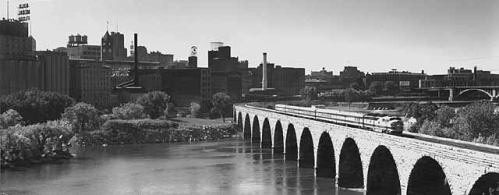
While the site will be closed for construction until spring 2027, the public is invited to visit the surrounding area, take in the view from the Stone Arch Bridge, attend interpretive tours and participate in programming at the new Owámniyomni Engagement Space. The Owámniyomni Engagement Space is adjacent to the project site and is located in the Crown Plaza building, directly across from the entrance to the Stone Arch Bridge.

Funding for the Owámniyomni restoration comes from a mix of public and private funders as the organization leads a $60 million fundraising campaign. To date, $40.5 million has been raised, thanks to early support from Paul and Mary Reyelts, Mark and Nancy Wilson, Mellon Foundation, Bush Foundation, McKnight Foundation, Minneapolis Foundation, and hundreds of additional supporters. Funding is also provided by the Minnesota Environment and Natural Resources Trust Fund and Outdoor Heritage Fund.

The organization is on track to gain ownership of the federal land through conveyance from the U.S. Army Corps of Engineers in late 2026.

To learn more, visit the project website at owamniyomni.org/design.

Monday
May042026

Enjoy Coffee and a Donut May 15 at Government Center Plaza for Bike to Work Day

Participate in a group ride to downtown Minneapolis!

May 15 — Government Center Plaza — 7-9am

The City of Minneapolis and Hennepin County are partnering to give bike commuting a boost on Bike to Work Day, May 15th. A short program of remarks from local elected officials will kick off at 8:15am. Grab free coffee and donuts (while supplies last!) on Government Center Plaza, meet fellow bike commuters, and grab a sticker to spread the word.

This event is part of the City’s As You Go MPLS campaign, which highlights multi-modal infrastructure in Minneapolis and spreads awareness about the economic, environmental, and social benefits of walking, bicycling, and taking transit. 


Sunday
May032026

A Discussion with Autumn Ness, Playing Almira Gultch and the Wicked Witch of the West in the Children’s Theatre Company Production of The Wizard of Oz

Article by Becky Fillinger, photos provided

Autumn Ness in Children's Theatre Company's 2026 production of The Wizard of Oz. Photo by Glen Stubbe Photography

Autumn Ness takes on the iconic characters of Almira Gultch and the Wicked Witch of the West in Children’s Theatre Company’s The Wizard of Oz. And she is marvelous – whether grabbing Toto, throwing fire at Scarecrow, summoning flying monkeys or gloriously melting away. We talked to her about playing villains for a primarily children’s audience, the characters’ motivation and why this play resonates with generations over time. Tickets will go fast for this experience – buy them here.

Q:  You’re playing both Almira Gultch and the Wicked Witch of the West in this production. Do you see them as the same person in different worlds, or as two distinct characters connected through Dorothy’s imagination? 

A:  I see them as the same person, and when we leave Kansas and go to this world of technicolor in Dorothy’s imagination, the filter comes off. The Witch has all the cruelty of Gulch, and all the hated for those who don’t automatically bow to her will. The way Gultch uses the law and power in the town is the way the Witch uses her Monkeys and her Winkies. 

Q:  Almira Gultch is often remembered simply as “the woman who wants Toto taken away.” Do you try to humanize Gultch?  

A:  Oh, she’s absolutely the villain in both worlds (and clearly a cat person!). Approaching the character truthfully means finding people in the real world who have an ungenerous view of life. The Gales are a loving family, and that makes Miss Gulch crazy!

Q:  What do you think motivates Gultch? Is she a Kansas Karen - purely rigid and rule-bound, or is there something deeper driving her actions? 

A:  The reason the script is so brilliant is because the scene with Miss Gultch isn’t more than three pages long, but we learn everything we need to know. Gultch is completely driven by money, and believes her money should allow her control of everything and everyone. She threatens a lawsuit, which the Gales can’t afford, she outright threatens to take their farm, which is their livelihood. So, she’s motivated by a belief that her money makes her superior, and control.

Autumn Ness

Q:  Almira Gultch transforms into the Wicked Witch of the West in Dorothy’s imagination. How do you physically or vocally plant the seeds of that transformation? 

A:  That’s such a great word for it - seeds. We use the Kansas scenes to show that Miss Gultch is a little shrill in her voice, that she’s got these bony hands that are always reaching, that her eyes are sharp and mean. That way, in Dorothy's imagination, she can become green and grotesque, and we still recognize her as this person Dorothy knows in Kansas.

Q:  What are the fun (or challenging) differences between playing a grounded Kansas antagonist versus a full-blown Oz villain? 

A:  The challenge is to let the character grow, so it’s not one note. As fun as it would be to CHARGE on stage for the first time, and shriek, and be as rotten as you like – it would get old over the course of the show. So, we need to build in peaks and valleys, so she continues to show new layers with each scene.

Costumes - Credit Lex Liang

Q:  Is there a specific moment where the “handoff” between Gultch and the Witch feels most powerful for you? 

A:  I always loved in the movie how the tornado scene had that great special effect, from Gultch riding her famous bicycle, to the witch with that blowing cape on her broom. I love that in the force of nature, there’s like this chemical reaction that turns one character into another!

Q:  The Wicked Witch has such an iconic voice and presence. How did you find your version without imitating what audiences may expect? 

A:  Funnily enough, the extreme nasal quality of the Wicked Witch is actually a very healthy way to use your voice 10 shows a week! So, thank Margaret Hamilton for handing us that great healthy sound. But once you start adding costume pieces, and actors, and you’re interacting as the character - all that voice and body language comes very naturally. 

Q:  Performing at Children’s Theatre Company means your audience includes many young theatergoers. How do you calibrate “scary” so it’s thrilling but not overwhelming? 

A:  That’s where the outside eye comes in, and Rick Dildine will know where the line is and how to stay just on top of it. Personally, I remember the monkeys being much scarier than the witch. But everything is amplified when it’s a live performance, and the kids’ emotions run very high!

Q:  Is there a way to find humanity even in the Wicked Witch? 

A:  I think every line the witch says as she’s melting is a gem, and so revealing about her character. Remember when she says that Dorothy “destroys her beautiful wickedness.” She sees her villainy as something pure and strong. You have to admire that! And as actors, we always say, “The villain doesn’t know they’re a villain.” So, you always play your objective without commenting on it. “Oh what a world, what a world!”

Q:  Why do you think The Wizard of Oz continues to resonate with new generations? 

A:  I think not only are the characters Dorothy meets humorous and heartfelt and endearing, but Dorothy herself is a miraculous heroine. Through everything she endures, she keeps her kindness. And she’s so no nonsense, the way she stands up to the Wizard in the end is no less of a feat than the way she stands up to the Wicked Witch. The story of an epic journey doesn’t work if you don’t have Dorothy‘s heart at the center of it.

Saturday
Apr252026

Musical Director Isabella Dawis Discusses Ten Thousand Things' Production of The Most Happy Fella

Ten Thousand Things is staging a revival of Frank Loesser’s 1956 musical about love, deception, and understanding, running April 29 – June 7. We talked to Isabella Dawis, Musical Director, about the stripped-down production, performances in non-traditional venues and why we’ll all love a story about love, family and immigrants. Please see the list of venues and schedule below – it’s only going to be staged for a short while, so get your tickets today!

Q:  I read some history of the musical and learned that there was much discussion on what to call The Most Happy Fella - one critic called it "one of the most ambitiously operatic works ever written for the Broadway theatre.” Another called it a ‘music drama’ and that Frank Loesser (songwriter) "has now come about as close to opera as the rules of Broadway permit.” How do you classify the play and how do you approach the hybrid score as a music director?

Isabella DawisA:  I would say it's a musical that often leans in the direction of opera - though it actually includes a variety of influences, including jazz. I think Frank Loesser's score is very purposeful in how it conveys character and story. Opera is part of this musical because this story depicts Italian immigrants in America.

Q:  How does working in nontraditional venues (like community centers and correctional facilities) shape your musical direction?

A:  The acoustics for each venue are wildly different - sometime we're performing in a huge echoing warehouse, sometimes in a small carpeted room with low ceilings - so the cast and I have to modulate our performances accordingly using our volume, diction, and articulation. 

Q:  What challenges - or freedoms - come with reimagining a classic score for a stripped-down production?

A:  Rather than the lush orchestration of the original Broadway production, we get to bang around on xylophones and wood blocks and cowbells. 

Q:  Ten Thousand Things emphasizes accessibility and connection. How do you help performers use music to reach audiences who may not be regular theatergoers?

A:  We're so lucky to have several talented instrumentalists in our cast - Maje Adams on guitar and saxophone, Pedro Bayon on percussion, Phinehas Bynum on accordion and melodica, and Norah Long on violin. They bring this show to life in such a uniquely appealing and delightful way.

Q:  The Most Happy Fella explores longing, love, and identity - how does the music deepen those themes for our audiences?

A:  This piece centers around a community of immigrant workers who love music. They sing in Italian and play musical instruments to celebrate happy times, to share their traditions with their new friends in America, and to connect with their history.

Q:  What do you hope audiences carry with them after experiencing The Most Happy Fella?

A:  I hope audiences take to heart that this is a story about immigrants, love, and family.

Q:  If someone has never experienced a Ten Thousand Things production, what makes this one a great introduction?

A:  The music of The Most Happy Fella is absolutely gorgeous, and at the same time the story is unexpectedly real, messy, and human. I think this show will surprise audiences with its humor and frankness in how it approaches political and sometimes taboo topics.

Performance Schedule and Details

PAID Ten Thousand Things hosted performance times by day of the week:

  • Thursday & Friday 7:30pm; Saturdays 2pm and 7:30pm; Sundays 2 pm
  • Tickets are $40 suggested and Pay As You Are Able from $15-$60 

Open Book, 1011 Washington Avenue S

  • Thursday, May 14 (preview, all tickets $15)
  • Friday, May 15 (post-show reception)
  • Saturday, May 16
  • Sunday, May 17 

Hennepin Avenue United Methodist Church, 511 Groveland Avenue

  • Thursday, May 21
  • Friday, May 22 (post-show conversation)
  • Saturday, May 23
  • Sunday, May 24 

Capri Theater, 2027 W Broadway 

  • Thursday, May 28
  • Friday, May 29 (post-show conversation, ASL-Interpreted)
  • Saturday, May 30
  • Sunday, May 31

 825 Arts, 825 University Avenue W, St. Paul

  • Thursday, Jun 4
  • Friday, Jun 5
  • Saturday, Jun 6
  • Sunday, Jun 7 

FREE, COMMUNITY-HOSTED PERFORMANCES (reservations required) 

  • Thu, Apr 30, 12 pm at Fond du Lac Tribal & Community College (2101 14th St, Cloquet)
  • Thu, Apr 30, 7 pm at Zeitgeist Arts (222 E Superior St, Duluth)
  • Mon, May 4, 10 am at MSS (900 Ocean St, St Paul) (Audio-Described)
  • Tue, May 5, 1 pm at Touchstone Mental Health (2312 Snelling Ave, Minneapolis)
  • Wed, May 6, 1:30 pm at Avalon School (700 Glendale St, St Paul)
  • Thu, May 7, 9:45 am at Harmony Learning Center (1961 County Rd C E, Maplewood)
  • Fri, May 8, 7 pm at Project Success (One Groveland Terr, Minneapolis)
  • Tue, May 12, 1 pm at Dellwood Gardens (753 E 7th St, St Paul)
  • Wed, May 27, 12:30 pm at Cora McCorvey Center (1015 N 4th Ave, Minneapolis)
  • Thu, May 28, 1:30 pm at Transition Plus (2015 E Lake St, Minneapolis)
  • Tue, Jun 2, 2 pm at Episcopal Homes – The Gardens (1860 University Ave W, St Paul)
  • Wed, Jun 3, 12 pm at Interact Center (1860 W Minnehaha Ave, St Paul)

 Make a Donation

Friday
Apr242026

April 30 Art Opening at the Bridgewater Lofts

Join us in celebrating our 32nd exhibit, Beautiful Margins, and meet the artists!

Thursday, April 30, 6:00pm – 8:00pm
Bridgewater Community Room, 215 10th Avenue S
Wine, Appetizers and Dessert
.
Featuring: Beth Bergman | Nancy Bundy | Kasia Cymerman | Leila Denecke Brian Frink | Amanda Hanlon | Bonnie Hinz | Kelly Marshall | Peter Vanni
.
Take a Virtual Tour:
For more information or sales, contact Peter Zenner at pczenner@comcast.net.
Friday
Apr242026

City Seeks Feedback on Potential Indoor Playground in Downtown Minneapolis

The City of Minneapolis is assessing whether a new indoor playground and multi-use family play space downtown would be feasible and beneficial. The City is currently gathering input from parents and caregivers through a public survey. This survey includes questions about:

  • Family recreation habits
  • Desired amenities for an indoor playground
  • How frequently you visit downtown Minneapolis

The survey takes about 8-10 minutes to complete. Responses are anonymous. You may opt in at the end if you’re interested in participating in a future focus group.

Take the survey in English, Spanish or Somali

The goal of this survey will help planners determine whether to move forward, and if so, how to ensure any potential future space meets the needs of both kids and adults. Your feedback may be used to guide possible locations, programming and amenities such as food and beverages, so the space works well for families.